The Republic of the First World

June 5th, 2181, at about 0231 universal time, Earth was struck by a relativistic object in the sea between Greenland and Iceland. In seconds, the object had cleared the distance from Earth to the Moon. Earth’s atmosphere yielded in nanoseconds, the sky over the North Atlantic converting to plasma, then parting, in less than an eyeblink. Billions of tons of seawater atomized in an instant as the impact briefly outshone the sun, blinding people as far away as the Moon. Wood, plastic, steel, flesh and bone turned to vapor within thousands of miles of that relativistic bolt. A supersonic air burst radiated outwards from the impact, flattening nearly everything in the Northern hemisphere. Vacuum snapped through the tunnel of plasma to meet the liquefied mantel as a column of ejecta erupted from the wound like an apocalyptic flower, changing Earth’s tectonics forever. Over the next several minutes, Earth cooked, her atmosphere rippling with high-pressure waves and lethal temperatures, ruining Earth’s climatological equilibrium to this day.
6.8 billion people eventually died on Earth as a result of the immediate impact and ecological apocalypse that followed. The climate would rebound over the next several months, beginning a century long ice age as steam and dust choked the unstable atmosphere. The impactor was known to be just a few meters in size. It was theorized to have moved at least half of the speed of light. It was later discovered that the stealthy object had been detected by many sources but none that could definitively identify it. After all, interstellar objects were not uncommon, and no one was looking for an object with that kind of relative velocity. Such a fast moving object could never be seen where it truly was. But thanks to these observations, the trajectory of the object could be traced to the Spica Nebula.
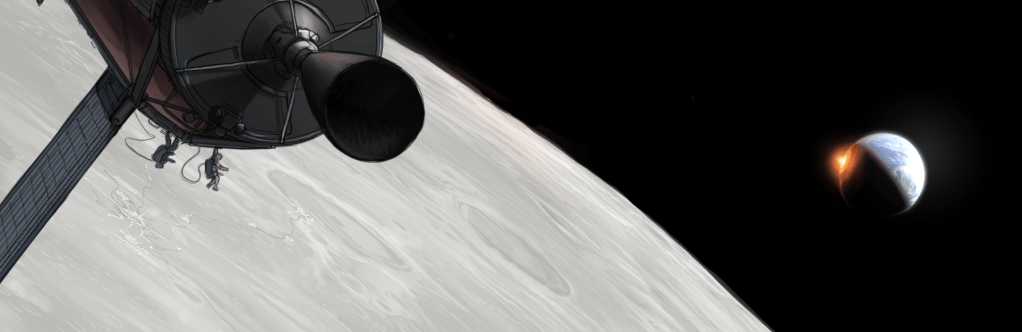
Whatever the source of the impactor, it fundamentally changed the course of human kind. Earth was forever scarred, the old world was swept off its face. Plate tectonics were disrupted and changed. The atmosphere teetered on the edge of sustainability for years. The seas churned and boiled before they finally froze. The biosphere was lost forever. An infinite number of histories and cultures were lost for all time. No nation was untouched by the fallout. Those that were unscathed by the immediate effects of the impact were ravaged by the climatological challenges that followed. Earth continued dying for years after the catastrophe.
Luna and the space around Earth already housed a few million people. Systems stretched for capacity as refugees flooded space. Governments that hadn’t simply collapsed were reseated on Luna, but there was no order to the chaos. The old nations with greater space presence and wealth gained the most footing after the impact.
So it was that the surviving seats of government gathered on Luna to establish a new international collaboration. The pressure to join was driven by survival, especially for those governing bodies that found themselves without viable territory and infrastructure. They formed a committee for legislation and leadership, then later instituted a model of representation for the Earth-Luna sphere and territories. The new republic was officially recognized in 2183 after a bloodless consolidation of administration in Luna sphere. The Republic of the First World emerged with the combined military force of the old world nations and the remaining industrial base to build more, retaining its position as the sole military force in human space.
Today, the RFW governs all of Luna sphere, much of Venus sphere and nearly all Earth-crossing asteroid cities. It maintains territories in the main belt, Mars sphere and Uranus. It retains a tenuous territory in Jovian space, a point of contention with the Galilean Federation. The RFW has historically been the most populous orbit of Sol, but many other regions are now trending to challenge that dominance.


Earth
Earth was never uninhabited. Populations, by sheer tenacity, managed to survive the apocalypse. Most of these groups were in the South Pacific and South Asia, the opposite side of the world from the impact event. These survivors weren’t unanimously inclined to consolidation and unification. In the months following the catastrophe, Earth infrastructure completely failed. Entire geographic regions had to relearn to survive without the benefits of a global economy. New factions emerged as previous regimes collapsed. What resulted was a bitter and hardened piece of civilization that congregated in tiny sprawls around the bones of the old cities. Over the years, these bastions of survival gained prominence and sympathy from the spacing factions, though not all were so eager to align themselves with such civilizations. It was perceived, even centuries on, that the spacing factions abandoned Earth to its fate in the first several decades. Therefore, many pockets of society still abhor spacing relations.
Perhaps ironically, Earth itself is not entirely under Republic rule. The planet hosts numerous territories of other solar system factions. About 65% of the Earthbound populace belongs to the Republic. The other 45% is predominantly made of independent nations, mainly those founded after the impact event, several of which are openly adversarial to the Republic. Still, Earth is relatively conflict free as a result of the RFW’s governance of the system. Likewise, Earth industry still benefits from orbital trade agreements, particularly along the equator where the vast majority of space infrastructure was rebuilt. It should be noted that most of the areas aligned with the RFW are focused along this equatorial band, while the majority of independent nations are mostly North of it.
A Summary of the RFW Territories on Earth:
- Pacific Equatorials, notably Indonesia, the Philippines and New Guinea
- The Australian Territories, New Zealand and Antarctica
- Nearly all of Central America, South America and what remains of the Caribbean.
The Republic by Territory
Luna sphere
Easily the largest concentration of humanity in Sol, Earth’s moon is saturated with surface development and low orbit populations. Many tens of millions of people live their lives out under the direct governance of the Republic sphere.
Earth Sphere
The gravitational influence of Earth accounts for seventeen orbitals. Many of these cities are old, with a few dating back to the Iceland Event itself.
Venus Sphere
The Republic of the First World does not have sole command of the Venusian sphere of influence, but there are four orbitals that accept Republic governance, including Sevantis Blue, the first city over Venus, predating even the Galileans. Additionally, Citrine Dream, one of the Venusian-crossing asteroid cities, answers to Republic authority.
Asteroids
In total, the Republic has 27 asteroid states between the orbits of Venus and Mars. New Miami Spindle, Corpula Mesa, Conferito Grace and Jamali Carousel are among the largest. Additionally, the Republic maintains another nine asteroid habitats in the main belt beyond Mars. Of these, two are contested by the Galilean Federation
Jupiter
Mallatachi Ring and Hamilton are both Republic holdings in high Jovian orbit. They are the frequent target of Galilean Federation surveillance and political bolstering. Hamilton is a military hub for the RFW. After the Prestid Rebellion, Malla Ring maintains a sizable defensive force.
Uranus
Prospero, in high Ura orbit, acts as an RFW military hub. The many factions of Ura are more or less tolerant of RFW actions in the system.
Military
The Republic maintains the largest military presence in Sol. The Republic Space Force has seven numbered constellations. A numbered constellation typically encompasses the administrative capacity to command 70-100 spacecraft, depending on mission of that particular command. The RSF and supporting agencies maintain tens of thousands of collectors across the entirety of human space. Additionally, no other military in human space boasts a larger mobility network, with hubs in Mars, Jovian and Uranian spheres and nodes in almost every other theater of operations.
Transhumanism
The Republic is generally defiant of transhumanism, though not as staunchly as some other factions. As the primary governance of the seat of humanity, most flock towards human centralism, the idea that humanity shouldn’t deviate beyond some predetermined template lest it be lost forever. Human Centralism holds that humanity is biologically sustainable, if imperfect, and that manipulation of the form isn’t moral to that end. This is a highly contested subject as it is nearly impossible to draw the line between a semi baseline human and a transhuman. Does having genetically improved hearing make you a transhuman? It depends who you ask, but most centralists would say no. Does having genetically modified bone structure and orange skin make you a transhuman? It depends who you ask, but most centralists would say yes.
 Hibour