Quodilus Maris
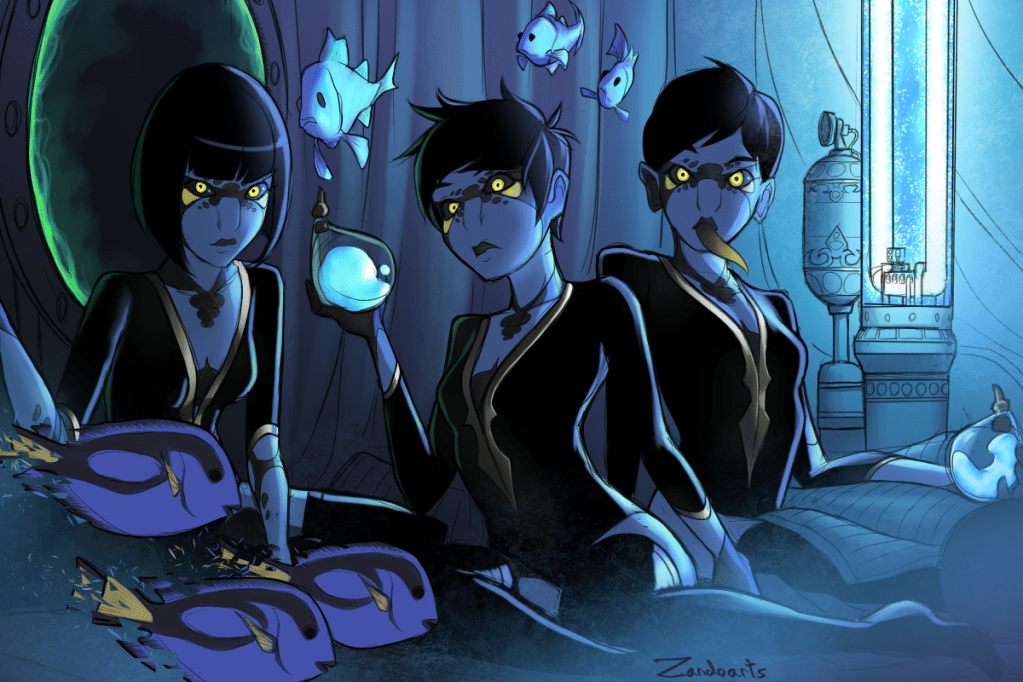
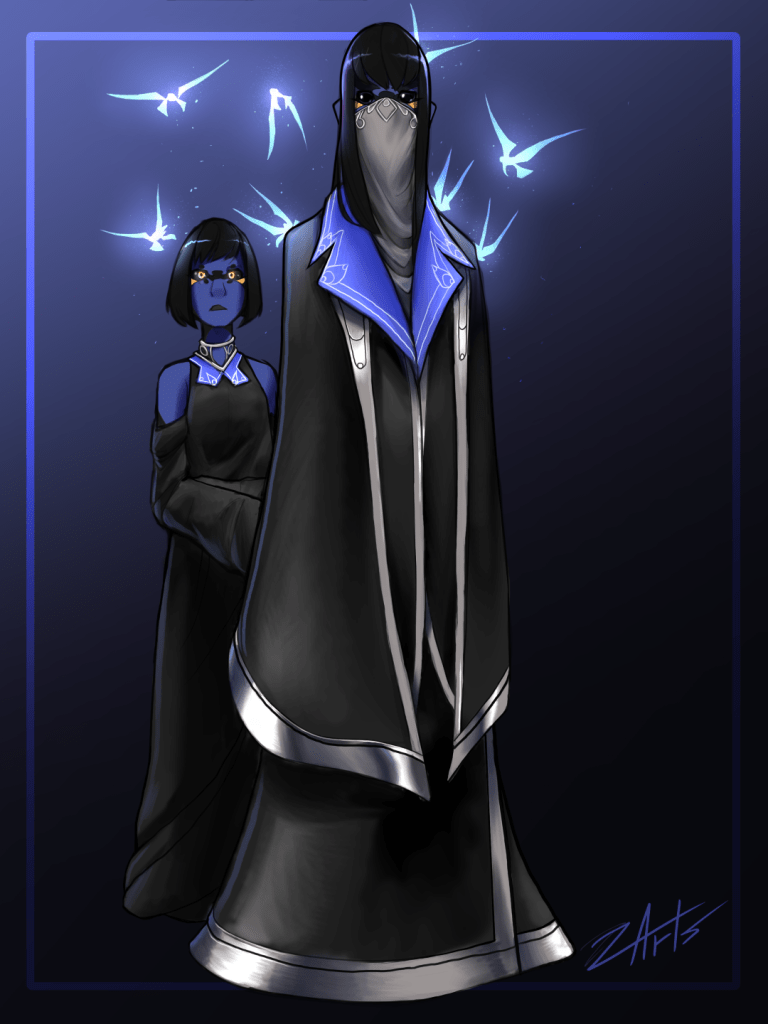
“A perfect doll, a perfect follower of Maris… that can kill you. I really need to emphasize that part. The nuns especially… Uh, the ones that entourage with a Telahus, your premium NIF security isn’t going to protect you from the kind of bioware these hypers are grown with.”
- TC#: 36
- TC Name: Homo Maris Minor
- Common Names: Quos
- Launch date: 2251
- CIT: 5
- Population: 21,300
- Reproduction: No, Lab grown
- Sex: Femme Vacale
- Lifespan: ~110
- Avg Height: 135cm
Origin and History
The Maris project was officially started under the name Project Aquarius in 2238, by Aquarius Transcended Solutions. The project goal was to provide an amphibious hominid to both Sol-based and, eventually, interstellar markets. Private markets weren’t necessarily the goal of Project Aquarius, as the prototypes envisioned would far exceed the price of most designer babies.
Aquarius Transcended Solutions pursued an iterative design process to their genome. Micro design processes interspersed major design updates. The company produced four of these major design phases before creating the modern Quodilus. While the Quodilus was very much still a prototype phase, it was the first model Maris Genome that was stable with acceptably minimal health complications and cybernetic integration. Therefore, with proper cybernetic certification, the Quodilus was put to market.
Prior to the Tichordia Concord, Quodilus sold poorly, and Aquarius Transcended hardly recouped their losses on the 5th iteration Maris. Financial concerns prompted the redesign and early release of the 6th generation Maris, Telahus, yet both generations were in production at the time of the Tichordia Concord and therefore the stipulations of the gene freeze applied. Both generations were official recognized as Class-A genomes and therefore granted species rights. This was especially significant for the Quodilus, as they were not designed to be capable of reproduction. A Concord directed production laboratory was established on Haumea to facilitate species continuity.
Biology
Quodilus have exceptionally high cybernetic integration (CIT level 5). At the time of their development, prior to the Concord, no other genome had more biocomputational tissue. Several more modifications were made prior to the gene freeze, resulting in an extremely powerful processing chimera. Quodilus have extraordinary computational power.
Quodilus have a form of cutaneous respiration that assists in cooling their processing abilities. Though it functions at reduced efficiency in atmosphere, the feature was designed for liquid medium. Modern quodilus enjoy lounging in water to ease their high-level thinking.
In addition to these more passive cooling measures, Quodilus have an overclock thermal protection feature. An auxiliary cerebral fluid, during moments of very high thermal demand, can flush into the digestive system, whereby the Quodilus will immediately regurgitate the heated fluid. It takes several days to replenish this fluid, so this reflex is normally only considered for emergency use.
The Quodilus trachea was purpose-designed for later modification. Between the 5th and 6th generation Maris, Aquarius was developing gills that would feature on the 7th generation. The integration was never completed. Even if it had been, the Maris would still be without functional vocal cords. Aquarius prioritized aquatic respiration over traditional vocalization.
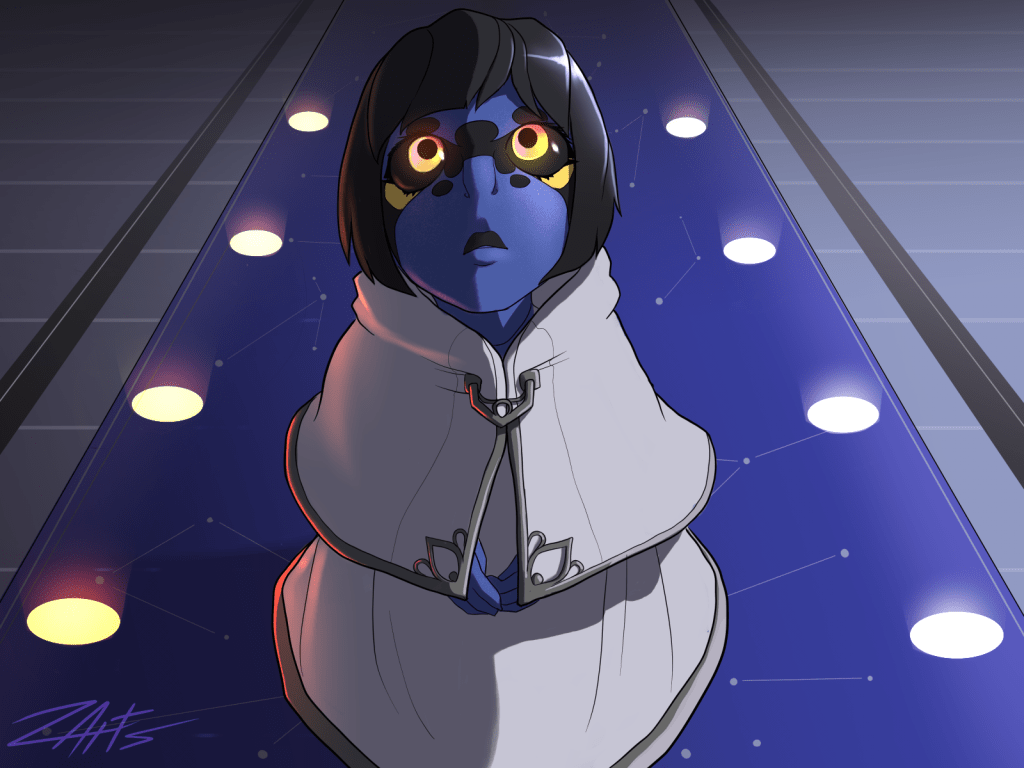
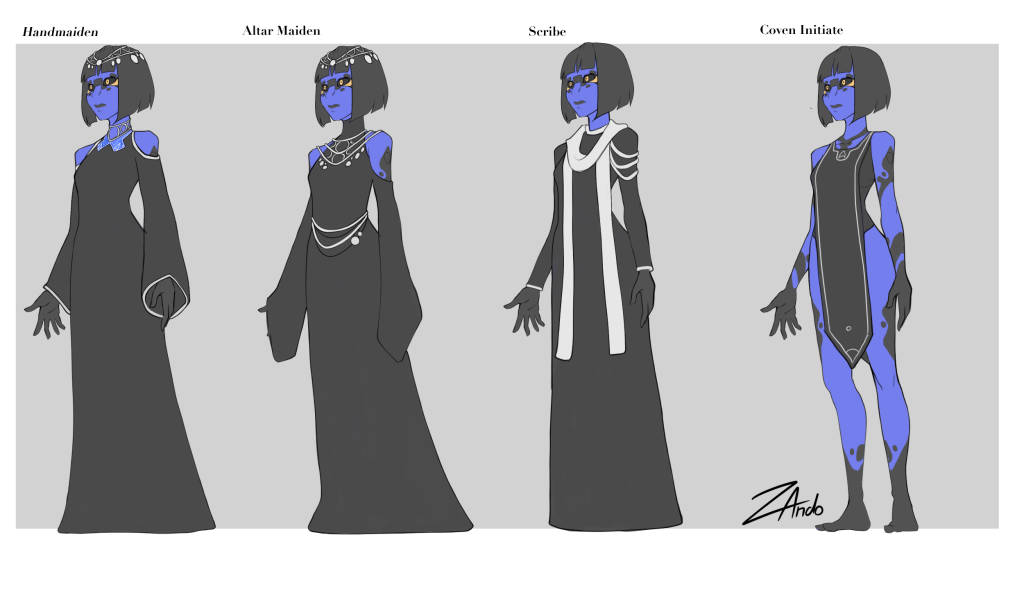
As with all transhumans in development during the twenty third century, aesthetics played an important role in branding. Quodilus were pigmented with traits from royal blue tang and various poison dart frogs.
The external ear was retained from baseline, though the interior ear was changed to incorporate underwater dwelling between 5-25 feet.
A prehensile tongue was incorporated to assist with underwater feeding. Quodilus were designed with 20 teeth, using an oral philosophy of simplification, with the incisors grown as a single, segmented piece.
Quodilus are Femme Vacale (Sterile, vestigial females). The design incorporated a vagina and biosynth uterus, but no ovaries, which were intended to be redesigned for the next species iteration. Quodilus have been described as asexual, experiencing very little drive for physical intimacy.
Like most class-A genomes, Maris do not age in a manner akin to baseline. A 20 year old Quodilus and a 90 year old Quodilus will look mostly the same. Cybernetic integration begins to break down between 100 and 115 years of age, making continued utilization unviable. As of 2370, only a handful of Maris have actually died of old age. The majority of Quodlius deaths have been elective euthanasia, typically around the ages of 105-110.
Culture and Demographics
Spirituality, Service and Subservience
The Maris religion was never intended by Aquarius. The entire culture of the Maris was a consequence of timing and genetic iteration. At the time of the gene freeze, the 5th generation Quodilus already held the 6th generation Telahus in high regard. Likewise, the Quos embodied the initiatives of the Maris project. They looked to the watery exoplanets beyond Sol and saw hope for a prosperous future.
Quodilus, being incapable of reproduction, required gestation and growth in a Concord mandated production facility at Haumea. The price of an individual Quo is significant, too much for the Kuiper Alliance to fully subsidize on a mass scale. It fell on the independent Telahus, who tended to inherit wealth after the gene freeze, to help fund the creation of their kin.
This early dynamic quickly evolved into the Maris social and spiritual stratum. Modern Quodilus are created at the whim of influential Telahus, usually in batches. Those quodilus, in turn, are indentured to that particular Telahus in a lifebond. The Telahus then fill the clergy, academic and leadership roles within the Theocracy, while the Quodilus undertake the clerical, bureaucratic and domestic roles. Despite what many outside critics claim, the relationship is mutually agreed upon and Quodilus willing accept Telahus leadership.
A widely held misunderstanding protests that the Maris religion exists to enforce a status quo. The actual basis of the faith is preparing the Maris for an interstellar future, to include genetic convergence towards an ideal Maris form. The faith therefore, like many other transhumanist faiths, suffers from a post gene-freeze dilemma. The Tichordia Concord permits the continued existence of the Maris in Sol, but prevents the species from developing any further.
Piety and Grace
Quodilus are a financial investment for the Telahus and coven to which they are bonded. From birth they are trained to behave in a manner that reflects gracefully upon the Theocracy. Things like posture, grooming, behavior and demeanor are all critical to Quos. Each individual sister is appraised by her compliance to the Maris ideal. This, combined with the fact that Quodilus have essentially no genetic divergence between individuals, means that individual members of the genome, particularly those made within the same batch, are completely identical.
Doll-like is a frequently used term when describing Quodilus. Society at large often pictures quos as decorated showpieces for the Theocracy. Quodilus, of course, revel in this conformity, desiring nothing more than to maintain the strict standards of Maris behavior. Sisters, especially as children, will practice for days on maintaining their mannerisms and matching their behavioral traits in an effort to appeal to the clergy.
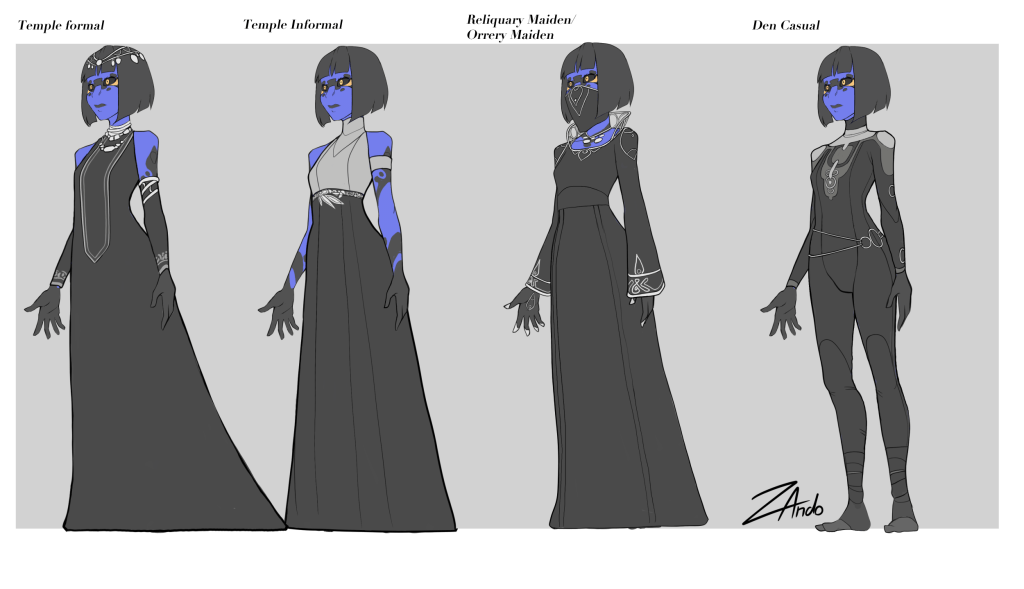
Most Quodilus clothing complies with Theocratic doctrine. Dark greys and vivid blues with silver, white or gold ornamentation is the norm.
Naming
Every Quodilus Maris is born with an official code identifier, but these are rarely used. Instead, Quodilus sisters informally identify themselves by their batch sequence. Three of Eight, Fourteen of Fifteen, Nine of Twenty Four. Traditional naming normally follows a batch convention. Celdet, Celva, Celia, Celiv, Celfa. Velva, Velta, Velsa, Velli, Vellia, Velka and so on.
Communal Covens
The system by which Quos are produced encourages dense communal living. A batch of sisters, no matter the size, are intrinsically attuned to each other. It becomes their family group. There are no parents in Quodilus culture. A sister group will do absolutely everything together. A lone Quo is an uncommon sight. They will normally act in pairs, at a minimum.
Communication
Quodilus were intended to communicate electronically. However a form of fluid-based syntax evolved shortly after deployment of the genome. Quos will stimulate a virtual fluid medium, typically in an somnoptic projection, to communicate visually with each other. Interpreting the visual medium is beyond the capability of almost all non-Maris.
The Maris consider it mildly offensive to be spoken to, instead preferring an electronic ping of greeting.
Touching is taboo in Maris culture. Quodilus will shirk away or present electronic barriers if physical contact is attempted.
Population
Quodilus, like their Telahus counterparts, are one of the least dispersed gnomes recognized by the Tichordia Concord. With only about 21,000 individuals as of the 2370s, Quos are designated critically endangered by the Concord and are expected to remain so for the rest of the century. It should be noted that most species without reproductive capabilities have a hard time moving beyond this status. However, Quodilus populations have been increasing exponentially over the last century. More Telahus generates more wealth to buy more Quodlilus, and Telahus populations, though tiny, have also been growing steadily.
It should be noted that only members of the Maris Theocracy are permitted to fund Quodilus production, though one could hypothetically delegate that right to a non-Maris with approval from all the covens. All Maris are therefore unified by a single faction, which is rare amongst transhumans.
Notable Individuals
Velia (2 of 15) of Lady Chiros, Coven of Hades Pala – In 2333, Velia provided her cybernetic capacity the reactor on a passenger brightliner. For fourteen days she augmented the fusion reactor’s governing computer, likely preventing a catastrophic failure.
Celio (11 of 22) of Lady Albina, Coven of Abatos Planum – Prevented the assassination of Lady Albina on Andvari Social in 2372. Her sister group was awarded honors by the Theocracy.
Saint Telva (3 of 14) of Aquarius – First Quodilus to die in 2266 and the first to be Sainted in 2289. Telva was a victim of a fire in the original Maris production facility in Uranus sphere. Her surviving sisters attested that she had pulled several of them to safety before succumbing to smoke and fumes. A branch of the modern facility at Haumea is named in her honor.
Fenra (19 of 41) and Felva (39 of 41) of Cardinal Monarch Ressala – Became the first Quos to visit the Republic of First World Congress in 2299, on behalf of the Kuiper Alliance relations.

 Hibour