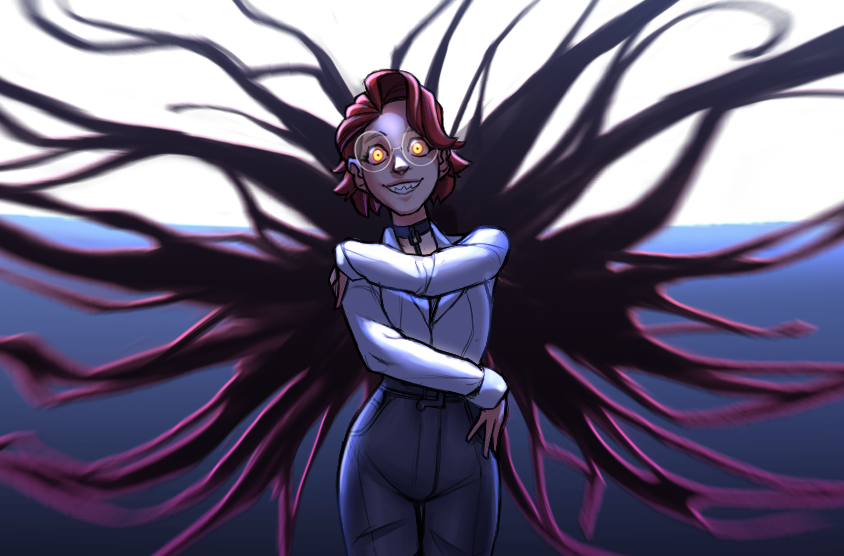
Quilakhi
“Yeah. If you want to talk about the poster child of anti-transhumanist rhetoric… look no further”
- TC#: 13
- TC Name: Homo Venesia
- Common Names: Quills, Quikkies, Quicks
- Launch date: 2262
- CIT: 1
- Population: 941,700
- Reproduction: Yes
- Sexes: Male, Female
- Lifespan: ~90
- Avg Height: 169cm
Origin and History
The business ambitions of Danghi International have been debated for a century. Most hybrid genomes, at the time in which the Quills were under development, were targeting aesthetic templates and longevity traits. While Danghi managed to develop a visually striking human variant, there are few marketable applications a venomous human.
Perhaps lending to the controversy surrounding Homo Venesia was the fact that only one viable individual existed at the time of the gene freeze. Yukli Gralli-Mi was three years old while the Kuiper Alliance deliberated at Haumea. The sixth variation in the Quill production line, Yukli had five peers who, just a month before deliberation, had perished in a transportation accident at Elerri Spinner. The Alliance decided to incorporate the subspecies, much to the dismay of other single-prototype individuals.
It was only after the fact that Danghi’s deep rooted corruption came to light. The company had done substantial ethnographic research into the subject of systemic genocide. With little ambiguity, company leadership had pursued and contributed to a political agenda that called for the active destruction of baseline humans from certain spheres. This agenda directly conflicted with the establishing order of the Tichordia Concord and threatened to discredit the young transhumanism movement. Luna and the inner systems were, understandably, appalled. Public opinion swayed policy and Danghi didn’t survive into the 24th century. Quills, however, would forever be tainted by the agenda of their origin company.
Biology
Quills are not particularly cybernetic. As a tier 1 CIT genome, they are born with the biosynthetic NIF capacity akin to that of most baseline humans. They have some computational matter in their eyes and ears, then little else.
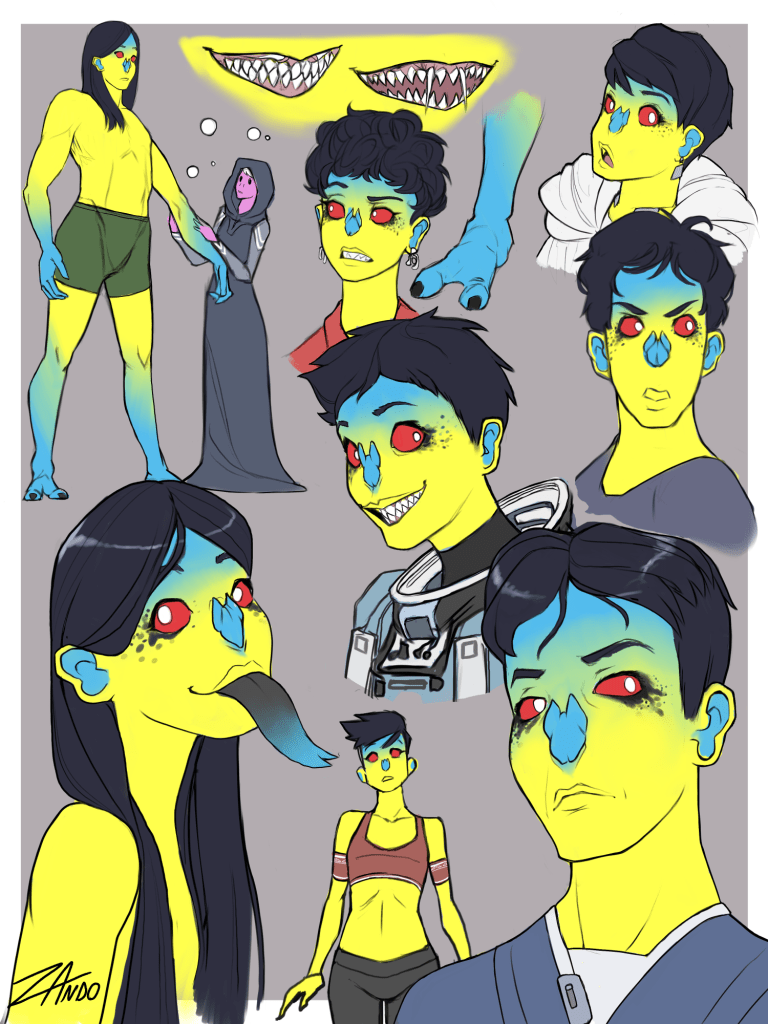
Perhaps the most famous trait of Homo Venesia is their venom. No other transhuman incorporates such a feature. Quill venom is a neurotoxin that, when not quickly treated, can lead to seizures, cognitive failure, and death. Venom is delivered via a pair of tubule fangs in the upper gums. The methodology behind this system is poorly understood. Modern humans typically do not defend themselves with their mouths. It is generally accepted that this feature was a choice of marketing, not functionality.
A Quill normally develops her venom at ten years of age. This is a point of contention with the society at large. A child carrying lethal venom, naturally, concerns some people.
A Quill stops producing venom by the time she’s 70, after which her fangs may fall out. Many Quill elect to have them removed when their venom ceases.
Quills are often stigmatized as cannibals. Danghi developed Quills with an enzyme that allows them to digest the tiny elements in biosynthetic cybernetics. These elements don’t exist in commercially produced meat, leading some to conclude that Quills are designed to eat partially synthetic humans.
Quills have one of the most unique feet within the human diaspora. Three large toes, two forward and one “heel” support the lean weight of the body. In full gravity, they are springy on their feet. In null gravity, they have shown greater dexterity with their feet than even those species with opposing toes.
Yet another rare trait, Quills have long, prehensile tongues. Like many of the other Quill traits, the original purpose, beyond market factors, are not known.
Quill reproduce sexually. However, in yet another quirk of Dangi engineering (or negligence), the sex ratio is especially skewed within natural born Quill. Only about one in seven Quill are born male. This is not an uncommon design feature in other species, but those genomes are normally supplemented by additional sexes, like optales or comales.
Culture and Demographics
Quilakhi suffer great prejudice throughout the solar system. Even from the onset, the reprehensible actions of their origin company invited criticism and distrust. There were very public initiatives to remove Quills from the Tichordea Concord very early on and there were very few members of the species to establish themselves at the time. These early prejudices forced Quills out of the public sphere.
The subspecies grew relatively quickly in isolated pockets throughout the Kuiper Alliance, most notably in the Pluchar sphere. Today, large quill communities can be found in even the largest Plutonian orbitals.
Monogamous relationships and courtship are uncommon amongst Quill. Families are normally matriarchal and males may participate in more than one household.
Many Quilahki exercise their venom glands by dispensing venom on a weekly basis. To many, this is species-affirming care, even though it produces a deadly byproduct.
There are a lot of uses for Quilakhi venom. It’s used to synthesize anti-venom. It’s used in the fermentation of various alcohols and cooked into some exotic dishes. In some orbitals, the venom is distilled into a compound that is then crystallized for jewelry.
Some Quills, particularly those living abroad (beyond the Plutonian system), have themselves defanged. This surgery involves not only removing the fangs but also the venom glands. This practice is quite controversial not only within the Quill community, but within the Kuiper Alliance as a whole.
Unsheathing fangs requires a deliberate effort and it is considered rude to bear your fangs to another. There is a common misconception that an angry Quill will bear her fangs involuntarily. In reality, most accidental fang bearing occurs when laughing.
Like most genomes represented within the Tichordea Concord, there is a Quilakhi embassy at Haumea.
Notable Individuals
Yukli Gralli-Mi – the only living Quill at the time of the Tichordea Concord. She was controversial only in the fact that the Concord moved ahead in preserving the species, despite her being the only individual. Yukli was an activist for her species. Today, about 65% of all Quills can trace their lineage to Yukli and one of her eight children, with the others driving from Yukli’s lab born siblings.
Dekli-Tu-Hugh – A monk of the True Light, Dekli famously established a the first Quill chapter of the True Light within the Lantern World Congregation. This action is often cited as the reason why True Light is such a popular belief amongst the Quill.
 Hibour