Mercury and the Solar Empire
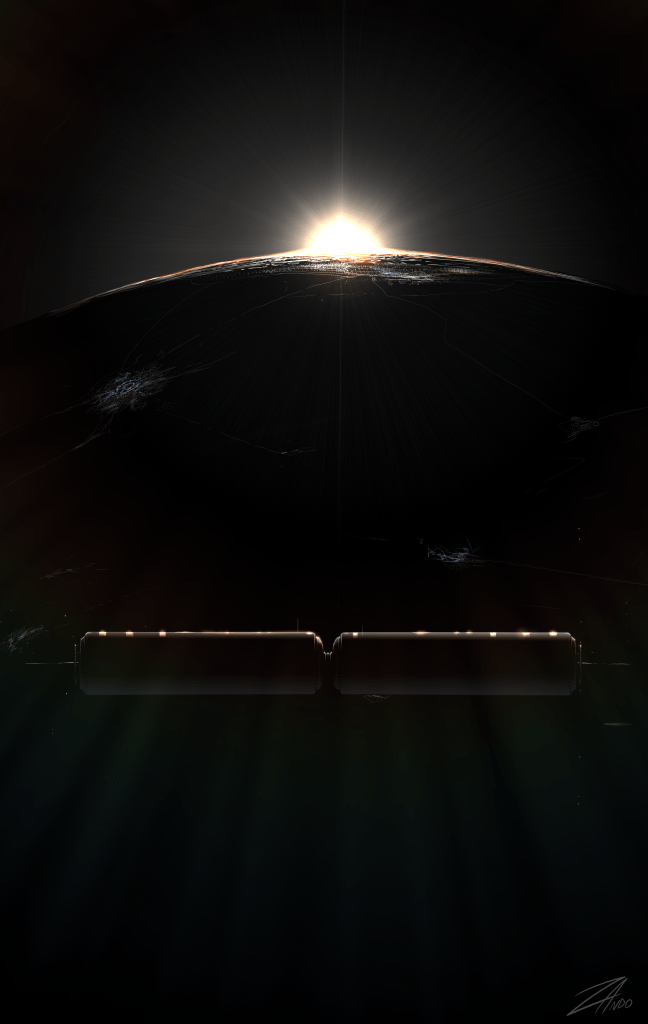
Not only is the Solar Empire not an empire, but it’s not even a real entity. The term Solar Empire came around after the fall of Earth in the 2180s. For a time it was thought that the industry rich Mercurian sphere would remain self sustaining and evolve as a new foothold of civilization. Of all the spokes of humanity that existed at the time of the apocalypse, the Hermian settlements were perhaps the most promising. Power generation simply wasn’t an issue. Mining facilities had been operational for decades. Ice processing was in full swing. Not only were asteroids already in orbit, but there were many more on the way. The equipment and facilities to process these asteroids were already on site as well. The transnational entities on Mercury had every right to be hopeful. For a few months, mouths and media spoke of the Great Solar Empire, the sphere of Mercury and the World of First Light that would provide a stable region in which human space might reestablish itself.
Hope forsook the 2180s. The Mercurian supply network failed as precious manufacturing resources, people movers and fuel rerouted to Luna and the asteroid cities. Earth’s moon had direct lines of communication with the devastated Terran nations. Governments fled there first and quickly reorganized their surviving assets… none were willing to consider lengthy transits of government assets to another planet. Earth was home, and while those invested there were willing to evacuate, they weren’t ready to abandon it.
Mercury suffered a fate similar to the Jovians, but to a lesser extent. The innermost world had to contend with years of borderline self sustainment, skirting the precarious edge of survivability. The budding civilization came through in the end, but not without sacrificing the old dream of unification. The Solar Empire that emerged was a fractured system of independent autocracies, hardened by a decade of living at the edge, cooperative but small enough in scope that they could deal with their own problems as they came. Although the orbit of Mercury has prospered in the two centuries since, the demographic and political situation remains more or less unchanged.

The Beneficiary of Sol
The legacy of the BoS predates even the Terran Impact Event. The early settlements that formed around those first landings are, for the most part, still thriving today. The Beneficiary is comprised of the three states of the Mercurian North hemisphere, Galveston Landing, Kandinsky and Purcell Commons. The BoS operates on a parliamentary system comprised of publicly elected delegates and appointed technical and cultural advisors. Over the last two centuries, the Beneficiary has made a concerted effort to adopt and integrate lost cultures of Earth. The Mercurian North, therefore, is one of the most Human-centrist bastions beyond Luna. It is not uncommon to find political candidates campaigning on anti-transhuman rhetoric.
The defensive capabilities of the Beneficiary are limited to a handful of orbital platforms and contracted security. Historically, Mercury hasn’t been a heavily contested frontier. It is a widely accepted belief if Mercurian nations faced an external threat, the Republic of the First World would likely break neutrality and respond.
First Light Federation
In a very general sense, the First Light Federation comprises the states that formed after the Terran Impact Event. These municipalities were established by entities other than the BoS. Port Clemmons was built by a Lunar cooperative in an effort to reestablish Earth influence over the Hermian sphere. The Austere Cities of the equatorial and Tir Ala on the south pole were all individual mining contracts from the inner system.
Unlike the Beneficiary, the First Light Federation benefits from a formal defense pact with the RFW.
The Free States of Iron
Mirasuta was a small, captured asteroid settlement within the Mercurian sphere, established in 2178. When the Terran Impact Event occurred, the asteroid facility boasted a population of 380. In 2183, after catastrophic power failure, Mirasuta reestablished contact with the Mercurian states, now with a population of 52, including three children who had been born during the dark years. Mirasuta is a name now synonymous with tragedy and survival. A million stories emerged from the apocalypse, but the Mirasuta Three is perhaps the best known amongst spacefaring civilizations.
In the recovery years, Mirasuta remained stoically independent, bent on growth and establishment. A human centralist religion, Third of Irons, emerged in the early 2200s. The cultural zeitgeist inherent in the city during the recovery resulted in a new formal governance, the Free States of Iron. During this time, Mirasuta claimed and began developing several other Mercury crossing asteroids.
Today, the Free States are still small. Mirasuta has seven additional asteroid settlements and a population of only 45,000. Yet their story is well known and Third of Irons has spread to remote corners of the inner solar system.
 Hibour