Kelsidon
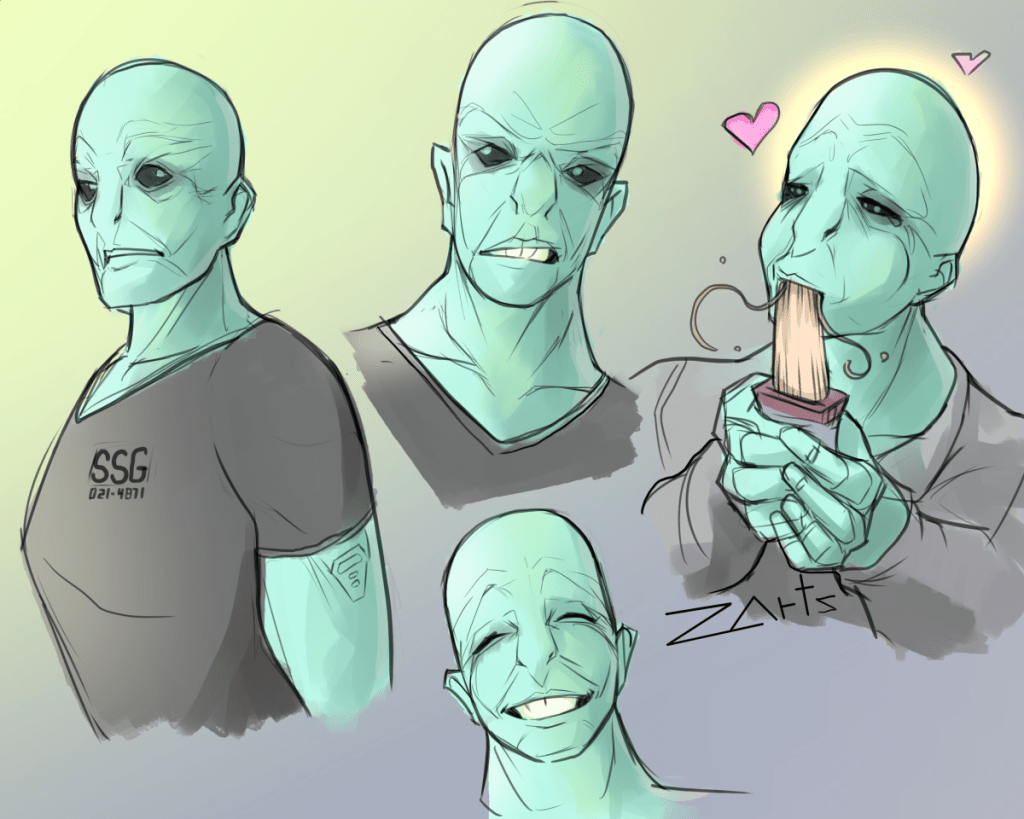
The celadon green individual before you was lanky, but firmly built. Glassy eyes betrayed no hint of scrutiny. There was no obvious distaste on the taught facial features. They merely stared, statuesque and tall, as if to do anything more might be a waste of energy.
- TC#: 31
- TC Name: Homo Magnanimus
- Common Names: Kels, greys
- Launch date: 2258
- CIT: 2
- Population: 10,312,800
- Reproduction: Yes (Artificially induced)
- Sexes: Nexale
- Lifespan: ~115
- Avg Height: 175cm
Origin and History
The Kelsidon project ran through three experimental iterations before the modern version, unofficially known as Kelsidon B.II.
The design philosophy behind the Kelisdon project was to create a long-lived space faring hominid with as little complexity as possible. As with many companies during the genespree, interstellar lifetimes was the key word in development and marketing. It was expected that future consumers wanted fewer, more comfortable generations in the void.
Biology
The Kelsidon was designed with long duration, limited gravity space travel in mind. The template started with a tall figure with long appendages. The structure incorporated long-toed feet with opposable digits for grabbing, effectively giving Kelsidos a fair degree of manipulation with their feet. Organs and internal processes were streamlined for energy efficiency. Every effort was made to create a body that needed less nutrition, less water, reduced respiration and reduced waste output.
The resulting design features created a being that is calm, deliberate, calculative and focused. Modern Kels tend to do well in positions that require mental acuity and patience.
The average adult Kelsidon needs 4-5 hours of sleep per standard day. However, Kels have a minor rest ability in which they can slow most of their bodily functions and enter a subdued energy state. An adult Kelsidon can maintain this state for about 36 hours before deep sleep is again required.
Kelsidons are biologically asexual (nexale). This was done to simplify the design process and to remove unnecessary behavioral traits from spaceflight. This had mixed results, as not only have Kelsidons been found to practice intimacy, but many actually modify themselves to further align with their gender identity. In these cases, Kels tend to adopt masculine gender identities.
Because Kels are parthenogenic, their genetic variation is limited from parent to offspring. Aside the effects of aging, there is little variance between first generation Kelsidons and more recent individuals.
Culture and Demographics
Early in development history, Kelsidons were coded with serials that started with two Anglohik letters. Typically these were some combination of a consonant and vowel. Despite having traditional names, early Kelsidons adopted the practice of identifying each other by these first two letters, often rearranging them to flow better as a single syllable name. Though Kelsidons are no longer given lab serials, the tradition continues. Names like Lo, Pe, Jo, Tu, Et, Ma, Ho, Ka, Fo and Fe are some of the most common.
The behavioral modifications made to the genome trend towards a solitary lifestyle. Kelsidon individuals are often just as satisfied alone as they are in group settings. There is little drive for kinship among most kels. For example, It is not uncommon to find intimate Kelsidon partners that only meet each other a few times a year.
Notable Individuals
Captain Et Crowl – A Space Security Guild enforcer based on Vesta.
Lo Smight II – The High Governor of the Lantern World Congregation during the Charon Crisis.
Fo Aklins- Disciple of Sol officiate who presided over the first intervention hearing of the Tichordia Concord. They’re credited with brokering peace between the Lunar Republic and the warring corporate factions of Uranus and averting a catastrophic confrontation, thus permitting the remaining negotiations. Fo Aklins is considered a progenitor of Transhuman rights. Fo Aklins died in 2359 after a lifetime of campaigning for rights and liberty within the Kuiper Alliance.
 Hibour