
Food
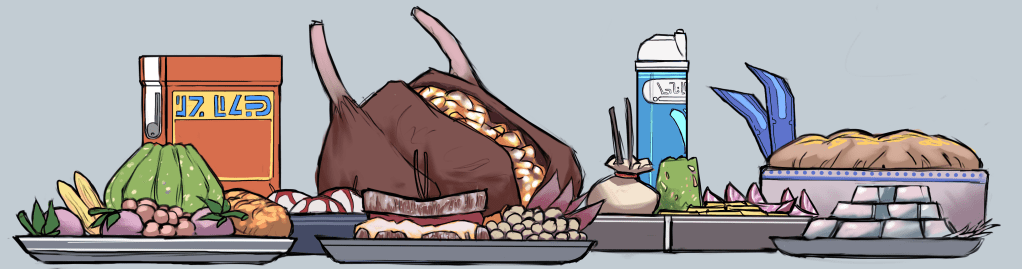
Origin and History
Food was first invented on Earth when one critter first decided to chomp on something. A few billion years later, food was finally brought off Earth by explorers in the twentieth century. While it is not entirely known when the first meal was prepared in space (taking raw ingredients to produce something edible), it is believed to have occurred prior to 2000, as it may have been necessary for the first crewed Mars landing attempts. It is certainly known that space-cultivated ingredients were being used in food preparation by the 2020s.
The loss of Earth resulted in a culling of culture and tradition that included many aspects of the culinary arts. Many Earth ingredients and preparation methods were lost forever, particularly those of niche methods produced in non-spacefaring nations.
Types of Food
Animal Meat
It is not known when meat products were first introduced to space, but it is known that various animals were brought to low Earth orbit in the twentieth century. Surviving film images depict dogs, non-human apes, small Earth birds and rodents, all serving scientific, engineering and presumably, early meat preparation.
Today, live animal meat is available in most large orbitals, though it is far less common and far more expensive than synthesized proteins. The average citizen on a large orbital might expect to see live meat just a few times a year, depending on the sphere of influence. Live meat is usually less common in deep space and more prominent in major spheres. This is partially because meat isn’t commonly shipped interplanetary.
Few Terran species survive the apocalypse of Earth, therefore most modern meat stock is comprised of artificially cultivated genotypes, with some exceptions. Several herring and salmon stocks survived in the post-TIE era and many of those fish stocks were distributed throughout the solar system in the decades that followed. It is therefore believed that these fish represent the only remaining “taste of Earth”.
Examples: Lunar pork, Martian pork, chicken, quail, ipek, golibird, herring, cod, salmon, muckfish, lancefish, kepper, beef, squid, crab, lobster, shrimp, mealworms, bakibugs, clams.
Synthesized Proteins
Meat substitutes predate the space habitation era and were likely enjoyed during twentieth century spaceflight. It is on record that the early orbitals over Earth had the means of synthesizing proteins to offset the need for meat imports and livestock.
Synth meats are vastly cheaper and less resource intensive to produce than live meat. Even small cities usually have the means to produce sustainable quantities. Most humans therefore, consume synth meat on regular basis.
Artificial proteins can be manufactured with a variety of flavors, textures and densities. While many of these products are not designed to substitute live meat, such variety lends itself to some truly exotic and imitation markets. Everything from beef to mammoth and elk to alligator. There are even niche facilities that cultivate imitation human, though it remains quite controversial.
Examples of non-imitation proteins: Whuler, Bo, Soam, Kimi-pau, Spam
Examples of imitation proteins: beef, poultry, pork, horse, white and red fish, shellfish, mollusks, deer, elk, game birds, whale, alligator, clam, crab, lobster, frog, paleo-saurae, paleo-mammal, human.
Algae
Algae has been a staple of spacer diets since the dawn of spaceflight. Evidence persists that early space habitation efforts included small algae ecosystems. It is considered one of the oldest off-Earth agricultural products and has only thrived in the centuries since. Now, in a post-Earth civilization, algae not only provides the backbone of surplus food stock, but also a reliable and readily available ingredient for dishes all across Sol.
Green algae is considered a legacy product. It was largely unmodified and therefore less reliable in some settings. Today, genetically modified sage algae (confusingly still called green algae by most consumers), along with white, pink and black algae, make up the foundation of the market. All four of these variants have flavored sub-variants, with the exception of black algae, which really only comes in regular and sweet.
Examples: Sage (green), white, pink and black.
Fruits and Veggies
True agriculture did not begin in earnest until the middle twenty second century. At this time, small hydroponics and soil plots were used in settlements on Luna and Mars. On a very small scale, plants were cultivated on spacecraft and small orbitals, though it is thought these early models merely supplemented primary nutritional supplies.
The technology expanded rapidly, especially as larger, less resource limited orbitals were built. This proved to be a great boon to humanity when agriculture on Earth ceased in 2181. Had it not been for the farms over Luna, Mars, Jupiter and so on, humanity may have perished in the dark.
Today, some orbitals specialized in agriculture, but usually only in highly developed spheres. At large, shipping agricultural products isn’t cost effective. Additionally, orbitals prefer to have multiple failure modes, so having diversified agriculture on site is considered a necessity.
While true solar farms still exist, most farms are fusion grown. Crops thrive off the interior sunlamps of tubeworlds, safe from the radiation concerns from Sol.
Examples:
Leaf Vegetables: Modified kale, cabbage, spinach, mustards, lettuce, mallow, mint, water lilies, basil, celery, rice, berries, parsnip, parsley and grapes.
Root Vegetables: Carrot, potato, angnu, sweet potato, turmeric, turnip, ginsing, arrowroot, ginger, yam, galangal, tigernut, bollibo
Bulb, Stem and Peppers: Onion, garlic, leek, chives, asparagus, rhubarb, fennel, bamboo shoot, poblano, anaheim, habanero, bell pepper, fresno, quarter pepper
Beans: Kidney, pinto, black, soy, chickpea, mung, fava, red, white, martian, lima
Fruit: cherry, apple, banana, dragon, mango, coconut, fig, plum, avacado, passion fruit, guava, blueberry, raspberry, strawberry, grape, pineapple, orange, lemon, kiwi, blackberry and many, many more.
Nuts
Nuts were a late addition to space. Trees and nut producing flora were far too resource intensitve to cultivate in early space habitats. It wasn’t until humanity was well established with large, open orbitals that nut-bearing organisms could be sustained. Beginning in the 2130s, orbitals experimented with raising trees in controlled environments. By the 2170s, just years before the Iceland Event, major orbitals were growing the first arboretums. In a stroke of luck, a massive seed store was kept in Earth Conservancy vaults.
Examples: Walnuts, hazelnuts, acorns, sunflower seeds, almonds, kohla, apricot, beech, cashew, hickory, pecans and many, many more.
Grain and Cereals
Grains were introduced alongside fruits and vegetables, their history and implementation were largely the same.
Examples: Maze, wheat, rice
Fungi
Just as with fruits and vegetables, macrofungi have been harvested in space habitats for generations. Fungi have required less space than traditional agricultural products and have an aptitude for growing in any amount of gravity. Thus fungi crops have proven to be an ideal supplement for moon settlements food stores.
Examples: Shitakke, snow fungus, silky rosegill, enoki, button, oyster, burble, byri-gnomi, truffles
Grasses
Grasses are largely cultivated for feedstock for other organisms. They were introduced alongside vegetable farming and largely follow the same processes.
Cuisine
It is important to note that many traditional dishes predate the impact event on Earth. Much of the history surrounding food and its preparation has been lost.
Inner Solar System
- Roasted Orange Beef – Thin strips of spicy meat with a pepper glaze, then roasted with thinly sliced vegetables. Usually served in the cooking tray.
- Grilled Bo – Bo is a particular flavor of synthmeat. While there are plenty of ways to prepare it, grilled bo dates all the way back to the pre-TIE era, when the meat would be grilled directly on flameless heating elements. When hot all the way through and blackened crispy on the outside, the bo is skewered, drizzled with a sweet sauce, then eaten off the stick.
- Wellington Mat – A wellington is shredded synthmeat, first marinated in an tangy red sauce, then grilled and formed into small cakes. The cakes are then scooped onto a square of toasted flatbread.
- Baked Greencake – Greencakes can trace their lineage all the way back to early Lunar settlement when the first batches of algae were cultivated. Traditionally, a greencake is concentrated green algae with a yeast substitute and spices for flavor all mixed until it forms a curd. The curd is then baked and served with a savory garnish, sometimes a piece of chocolate.
- Salads – Cold dishes of leafy greens, small breadings or crumbles, beans, grains, cheeses, vegetable cuts and drizzled sauces. Some even contain cuts of meat, either cold or cooked. Usually served in a bowl or on a small plate as either an entre or a side dish.
- Shackleton Pigs – The story goes that early space settlers, likely continental explorers, ran out of protein rations. In an effort to improve morale, they began preparing bread cakes with a thin meat sauce and calling them farm-raised Shackleton Pigs as a sort of comedic reference. Apparently the name stuck, as today Shackleton Pigs are prepared and sold in restaurants, street venders and made in the home.
- Calli Roll – A dough pocket of white algae baked with an assortment of herbs and spices and stuffed with either tofu or a synthetic protein.
- Bud – A pale lager brewed in Earth sphere. The brewing company claims to have been founded in the nineteenth century, which would make it one of the oldest brands in Sol.
Mars
- Phobos Freijoada – A beef and bean stew first spun in low gravity cookers, later brough to the surface. Nowadays it’s normally served on rice, algae granules or quinoa.
- Phobos Couscous – Thick grains of rolled soy, steamed and spiced, then eaten plain or with assorted greens and chopped veggies. Throughout Sol, this is a commonly marketed Martian dish.
- Gurri – A sweet, pink algae paste mixed with sugar and jelly (usually mango or strawberry), then frozen and served as bite-sized blocks.
- White-Rind Stew – A hot dish of boiled white algae, cabbage leaves, potatoes and potato skins, fermented soybean paste and shallots. White-Rind stew sometimes includes tofu and vegetable strips.
- Kerries – A type of cereal made from spun granules of toasted algae. Originally made from green algae, these days it’s made from white, pink or sage. Kerries are sometimes distributed in other dishes. Kerries and cream, for example, is yogurt and kerries.
- Gim Been – A crisp liquor cultivated in Phobos sphere since 2109. Multiple companies make Gim Been today, a few of which claim that it originated on Earth in the pre-spaceflight era. Nearly 200 years after the Icland Impact Event, those claims are difficult to validate.
Asteroids
- Vestan Au Gratin – Baked potatoes, though the methods by which the potatoes are raised has varied significantly. Early settlers famously grew potatoes out of weightless bags.
- Tomates Farcies – The stuffed tomatoes of Vesta. It wasn’t until after the mining era that Vesta really invested in the agriculture required to sustain a large population. Tomatoes were among the luxury crops of those days and residents strove for ways by which to prepare them tastefully. Often they would be stuffed with a mix of wet grains, herbs, algae paste, breadcrumbs and in extremely special occasions, meat.
- Bouffée Verte – Green algae souffle. Much like Luna and the inner solar system, the asteroid states developed and dined on green algae in the early days of space mining. Bouffée Verte rises as it cooks until it makes a fluffy, green-tinted cloud. Two and a half centuries on, there are now many variations on the dish, including numerous other colors of algae.
- Asper-Po – A tea, distilled with dried blue leaves, famous on Ceres but now found at most major asteroid cities.
- Chasker Red – If there’s one thing humans are consistently good at, it’s making booze. Early asteroid technicians were no exception. Chasker Red was distilled with boiled algae broth in weightless storage cabinets in Ceres sphere until the first distillery opened in 2199.
Jupiter
- Spiced Sapkra – Flame broiled meat completely crusted with spices and finely ground breading. Usually quite spicy.
- Chool – Chunks of meat, usually live or synthetic paleo meat, slow cooked for hours, then stripped apart, then mixed with grains and served in a bowl. Usually garnished with thyme. Frequently reproduced throughout the solar system as authentic Jovian food.
- Lapri – Originally ground synthetic proteins in a yeast bowl, these days they are usually made of substitute paleo meat.
- Callistian Bread – Focaccia bread made in kiln. Originally made by early Jovian explorers in their construction kilns.
- Ganymeadian Grunkies – Toasted algae balls rolled with sugar and minced fruits. Grunkies are well known beyond the Jovian system.
Saturn
- Sunseed Sticks – Sunseeds were actually imported from Luna, but they really took off in the Saturnian system when eateries on Esvarra Centra started rolling them in thick dough sticks with spices. Workers and school age children could take them by the bundle, but now they’re usually sold as appetizers and snacks.
- Titan Truffles – The surface settlements on Titan used large fungi farms in the early days. Titan truffles are a modified species designed for longer shelf life and easier transportation. Still, the process of growing them proved difficult.
- Baked Sage Beans – Sage beans baked in a generous drizzle of fruit jams, a staple of household pantries.
Kuiper
- Kepproviv – A light algae based stew with grains and potato shavings added for fullness. The stew is known for being a bit bland, often used as a kind of palette cleanser.
- Balini-Mo – Layers of flattened algae with layers of bean paste, cooked slowly in a thermal jar until crispy all the way through
- Takimari Skewer – A luxury meal made of stewed chunks of real-beef, glazed in a sweet sauce and dusted with finely-ground nuts.
- Ohm Se – Neobosti for fresh core. Ohm se is salted raw meat cuts on toasted wafers. Premium Ohm Se is animal meat, but synthetic meat Ohm Se is extremely popular and widespread. It is consumed as a snack or an appetizer. Perhaps the most famous variant of Ohm Se is Homohm Se… the imitation human cuts served in the Scaldia Consortium.
- Moong Dal Poppers – Roasted moong lentils popped like corn & spiced
- Bi-Biryani – Layered rice and proteins heated very slowly in a thermal jar. Typical meat choices include either Soam or poultry.
- Anticuchos – Meat, usually heart or similarly styled synthetic product, marinated in vinegar and spices, grilled and skewered for serving.
- Gregivi dep Aul – Curds of dough with minced greens, first boiled, then dried for 12 hours, rolled in spices and served either on a plate (gourmet) or in a bag (casual). Vender food found on the street, in clubs, bars and social venues and at large public events.
- Chici – Peeled vegetable strips soaked in a brine, then roasted with herbs, spices, and nuts. The dish is then drenched in spouli sauce and served aesthetically in a spiral. Despite having no meat, the dish is considered quite premium, likely because nuts used to be very expensive in the Kuiper regions.
- Quenalla – A compact press of leafy greens, herbs, sour sauce, Miranda Cheese and bean paste wrapped into a thin vegetable meal crust, then baked. Usually served with a drizzle of savory Ola sauce.
- Charity – A sweet liquor born of the industrialization era in Ura. The origins of Charity are hotly disputed between the distilleries of Ura, with many dozens claiming to be the first. What is known is that Charity is now enjoyed both straight and mixed in a variety of cocktails.
- Lyca – A beer brewed in the the Aquasphere Polyprion in the Neptunian system. Lyca was homebrewed by early explorers to Triton. Now, the breweries turn out over 20 different variants, making it one of the most distributed brands in the Kuiper Alliance.
- Haumean Coffee – Unlike what the name implies, Haumean Coffee was first served in the Ura system. Venders on Miranda marketed the spicy coffee as a new Haemean recipe shortly after the first settlers landed on Haumea. The trend exploded throughout Ura sphere and the name stuck. The drink is now enjoyed throughout Uranus, Neptune and the Kuiper Belt.
- Vericean Kerr’mai – A very sour tea enjoyed mostly in the Pluchar system.
 Hibour