The Collective States of Saturn


Saturn is a complex and heavily populated collection of worlds that flourished in the post-Earth solar system. It’s said that the helium market begins and ends with Saturn, given that the planet accounts for nearly 60% of all the helium in human space. Prosperity permitted the growth of opulent cities, sprawling moon-based civilizations and all the means to provide and defend for them. The collective nations of Saturn maintain cordial relations with most inner solar system factions, including the asteroid states. Member groups within the Kuiper Alliance are friendly or neutral towards Saturn with the notable exception of Neptunian sphere, where a competing helium market, dominated by cartel-like mega corporations, aggressively competes for market share in the high orbits. Still, none turn a colder gaze upon the rings than the Galilean Federation, who bitterly pushes to end its dependence on Saturnian resources.
Yet the interplanetary relations hardly scratch the surface of the complexity of politics, economics and culture that make up the tremendously varied civilizations of Saturn. From glistening diamond cities of the Cassini division to the free ecosystems of Knox Torquist to the Garden City of Hyperion, the beauty and majesty of these realms are rivaled only by the planet that supports them.
Chrysalis Union

Often known by it’s alternate name, the Union of Free Saturnian Orbitals, the Chrysalis Union is a intergovernmental alliance of Saturnian nations. The Union is the political body of Saturn to which most outside factions interact with. The bureaucratic infrastructure is designed to simplify governance and defense across the system while permitting autonomy amongst the individual nation states of Saturn. In close compliance with the Space Security Guild, the Union standardizes immigration, import and export regulations while ensuring the free and stable flow of trade both inside the system and beyond it. The Crysalis Union is currently the largest governing body in Saturn sphere. The member states include:
- The Cassini Dependencies, including all four Diamond Cities
- Many of the Outer ring states, including Janus, Epimetheus and the Free Orbitals of the Bold.
- Prometheus
- Bosphora (Mimas)
- Icthardia (Enceladus)
- Dione sphere, including the Federation of Dione, the unfederated city states and both partially deconstructed trojan moons
- Methone and Anthe (Alkyonide moons remade into orbitals. Pallene is entirely deconstructed)
- The United Orbital Sphere of Rhea (UOSR)
- Titan, including all orbitals, the Aurdus Conjoinment and most nomad houses
- Cadiz Hale (Phoebe)
- Four additional orbitals beyond the orbit of the round worlds
Concord of the Ring Worlds
Initially established in opposition to the Union, the Concord of the Ring Worlds now shares in all regulatory actions of the Union, with the exception of defense. These states do not contribute to the combined defense of the sphere, but are permitted to conduct the defense of their own spheres individually. The Concord Worlds include:
- Pan and Atlas
- Dozens of tiny stations in the innermost rings.
- Esvarra Centra (Tethys and both partially deconstructed trojan moons)
- Knox Torquest and Charlette, 2 Free orbitals beyond the orbit of the large moons
Hyperion Pact States
The Hyperion Pact is a loosely affiliated alliance of several major players in the Saturnian sphere. Little more than a mutual defense agreement, these nations are effectively independent. Each of them has either declined or been excluded from the UFSO or the Concord membership.
- All four independent city states of Hyperion
- Proxis Saturnia, Takya, Caven M’Aqua, and Cajamarca, four orbitals in high Saturnian orbit.
- Ymir
- Both the Equatorial and South Coalitions of Iapetus
Independent States
Beyond the three larger bodies, Saturnian sphere hosts fourteen additional settlements that are either independent or are directly associated with other bodies in Sol. A few notable examples include:
- Neshtoil, a Galilean Federation aligned trade hub with a military presence
- Extassa Circuit, a Kuiper Alliance trade hub
- Sky’s Hope Saturnia, a sanctuary of the True Light of Sol
Transportation Infrastructure
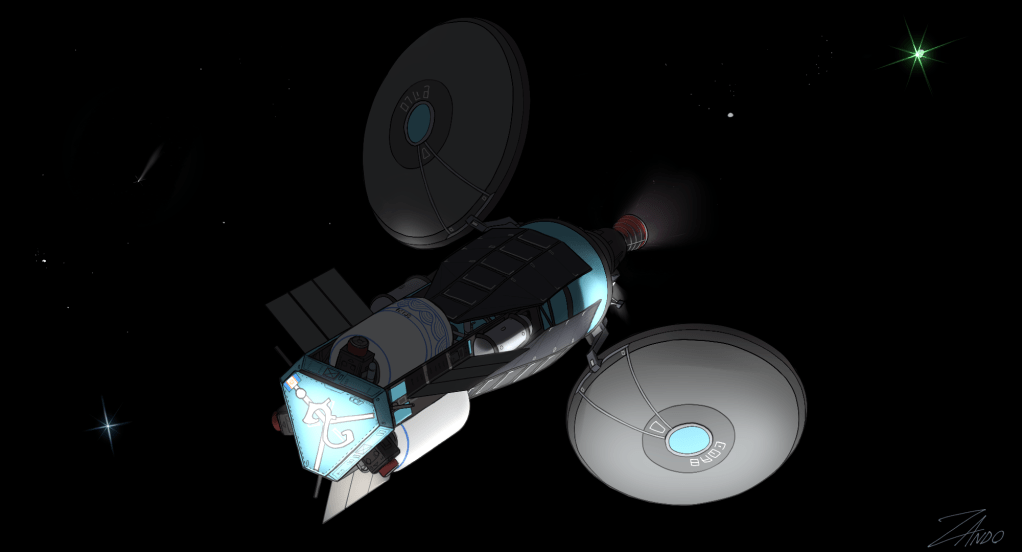
The Chrysalis Union has one of the most successfully implemented lightwebs in human space. Nearly all moons have co-operated, Union owned laser batteries that allow for frequent travel through the system. Orieles and beamwings make daily transits between hubs, carrying thousands of passengers and countless tons of cargo. With such an immense logistical effort, it is often said that if Saturn was totally unified, it would rival the industrial base of the entire RFW.
Helium
Saturn, historically, has been the base of the market for helium-3 and other gas giant resources. At any given time, thousands of harvesters are sifting the atmosphere. For two centuries, the industry has been a core pillar of Saturnian society. Many cities owe their existence to either the direct harvesting of atmospheric resources, or the services and amenities that support that harvesting.
Military
The largest military in the Saturnian system is the Chrysalis Coalition, a combined force made from the member states of the Chrysalis Union. However, the coalition has never been deployed beyond Saturn and nearly all enforcement actions to date have been defensive in nature. Even within the coalition, members often posture against each other.
Beyond the Chrysalis Union, the member states of the Concord of the Ring Worlds each maintain at least a meager defense force. The Hyperion Pact however, is well armed for its size. Hyperion in particular has a disproportionately large combat force, having received a lot of military aid from the RFW over the past several decades.
 Hibour