
Clothing and Wearables

Technology has ebbed and flowed several times throughout history. Personal integration was low during the initial stage of space exploration. Personal computers, for example, were usually worn or carried. Technology was part of the environment and less part of the person. That slowly changed as humanity marched into the 2100s. Cybernetics reached the commercial market early in that century and, though somewhat simplistic and crude in implementation, they were fielded to millions of customers. As the 2170s came to a close, personal technology and user had nearly morphed.
The Iceland Impact Event changed a lot of things, personal technology included. For one, manufacturing froze across the solar system, ending decades long supply chains for the manufacture and distribution of cybernetics and computers. Economies crumbled across human space, ending financing options for personal technology. Networks failed, materials dried up and businesses shuttered. Personal technology took a major step back until 2200, when many of the modern commercial conglomerates entered recovery and reconstitution.
The twenty-third century was the era of genetics, deep cybernetics and integrated personal technology. Networks moved away from remote equipment and onto the users themselves. In 2180 it was estimated that 1/24 humans had any kind of neural augment, in 2220 it was 1/18. By 2260 the floodgates were fully open and only 1/70 human beings did not have an neural interface.
Utilizing, powering, cooling and augmenting these cybernetics fell to wearable products. Jackets could help cool your internal implants, necklaces could act as transmitters, shoes could have additional sensors, undershirts might include tiny battery cells. Not only had the realm of personal technology moved into the user, functionality could now be carried or worn.
Clothing
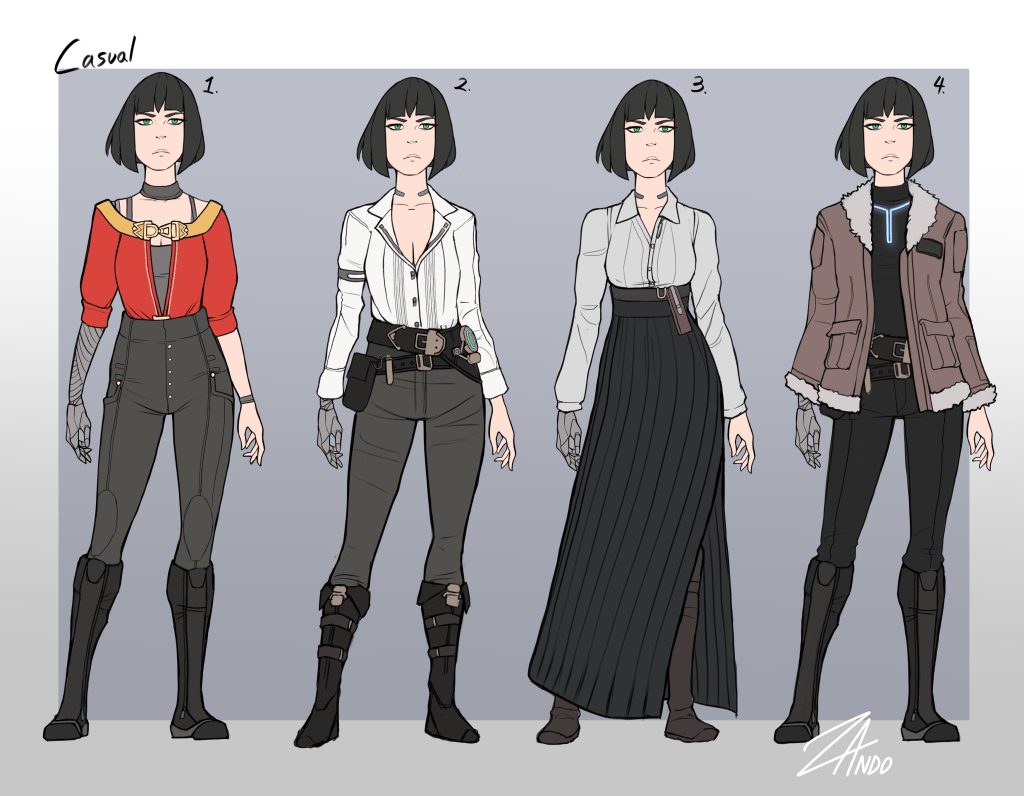

Clothing has dispersed in both style and function. Despite billions of human beings living in space, clothing doesn’t necessarily conform to the constraints of low-gravity. The average human dwells within the Earth-like gravity of a spinning orbital, only transitioning into low gravity environments when traveling between orbitals. Likewise, the time and distance separating markets results in significant stylistic deviation. Different orbitals often follow different clothing trends. Orbitals themselves will likely harbor countless subcultures with their own clothing trends.
Materials therefore, are the true limiting factor of clothing and styles in the twenty fourth century. Though plant based fibers still exist, the majority of clothing material is synthetic, owing to both it’s durability and functionality.
Material Types
Photofiber – Threads that act as photovoltaic panels. These are most useful for absorbing energy from the sunlamps of orbitals, usually to power other components on the garment. The fibers themselves, depending on the grade, can also be woven to make aesthetically pleasing designs.
Huefiber– threads that change pigmentation along their length.
Lightweave/brightweave/lightfiber – Threads that illuminate, often on a gradient or pattern, but typically only one color. When woven in large numbers, they can produce visual effects, images and animations.
Thermoweave/sinkweave – A heatsink fiber that operates as a micro-radiator. Tends to be semi-rigid when woven in mass, so thermoweave threads are usually woven amidst non-thermoweave threads. Thermoweave is most frequently used in cooling garments that have other electrical components.
Heatfiber – A fiber designed to provide heating, often used in cold wear gear. Famously invented on post-impact Earth and used on Mars and Titan.
Pulseweave – Fibers that contract with a stimulus, usually electrical current or water.
Flexweave – A catch-all term for dozens of synthetic thread grades that integrate with more specialized fibers. They come in various ratings of rigidity and thickness.
Bangweave– A type of pulseweave that expands with abrupt kinetic energy, absorbing and distributing the impact. Used mostly in armor.
Guardweave– A heavier version of bangweave. Guardweave feels almost like plates and tends to be expensive to produce in quantity. Still, guardweave is sometimes attributed to the decline in traditional firearms usage in the twenty third century.
Bathysflex – A type of synthetic weave that expands and grows rigid under pressure. Used in submersion suites for liquids or atmosphere.
Coreweave – A catch all term for fibers with processing capability. Usually expensive, these threads are mostly used in high-performance garments or those with military or specialized requirements.
Wickweave/capiweave – liquid cooling threads. Microtubes that function similarly to thermoweave.
Humweave – a thread that vibrates almost imperceptibly when a stimulus is applied. This has a variety of functions from sound muffling to waterproofing to pleasure garments.
Leathers– Synthetic leathers and skins, usually used in luxury items, furniture, fashion pieces or very particular environmental garments. Real leather also exists, though it’s considerably more expensive. Real leather is produced from legacy livestock and gene-modified life alike.
Cottons/hemp/plant fibers – these materials are still produced in mass, but are sometimes difficult to integrate with specialized synthetic weaves.
Wearable Technology

Prosthetics – Despite the massive strides of gene editing technology, organic limb replacement is still a tricky and expensive business. Limbs often need to be grown in batches to produce just one viable replacement. An adult limb might take several years to mature. Occasionally, integration is only partially successful.
Prosthetics are the far cheaper, far faster alternative to limb regeneration. Modern prosthetics can be custom built to fit body type. They incorporate electronic nerves, interface with the circulatory system, provide some level of tactile response and produce a full range of human motion. Many limbs can even be made to feel like flesh or skin.
Projectors, beamers, flashies, barkers – all names for wearable devices that interface with the cybernetics of others, usually for the purpose of generating somnoptics and sharing data. These are especially useful if one’s cybernetic processing power is limited.
Opticals– Not to be confused with cybernetic eyes, opticals are wearable modules that either interface with optical cybernetics or filter them. The term effectively encompasses any glass or monocle style accessory that allows a function not provided by the wearer’s eyes. Common examples include darkvision spectacles or monocles, as only some transhuman eyes permit true darkvision.
Assemblers– garments that are so deeply manufactured with pulseweave and huefiber that they can essentially transform into another garment. Usually this is an expensive aesthetic function, but they also have military and industrial functionality.
Flockmochs– Swarmbot based accessories. Usually formed like tiny tetrapods or decapods, these miniscule robots are controlled by a beefy neural interface or projector and can form a multitude of shapes and garments. They have application in fashion and functionality.
 Hibour