
Cities and Settlements
The History of Space Settlement
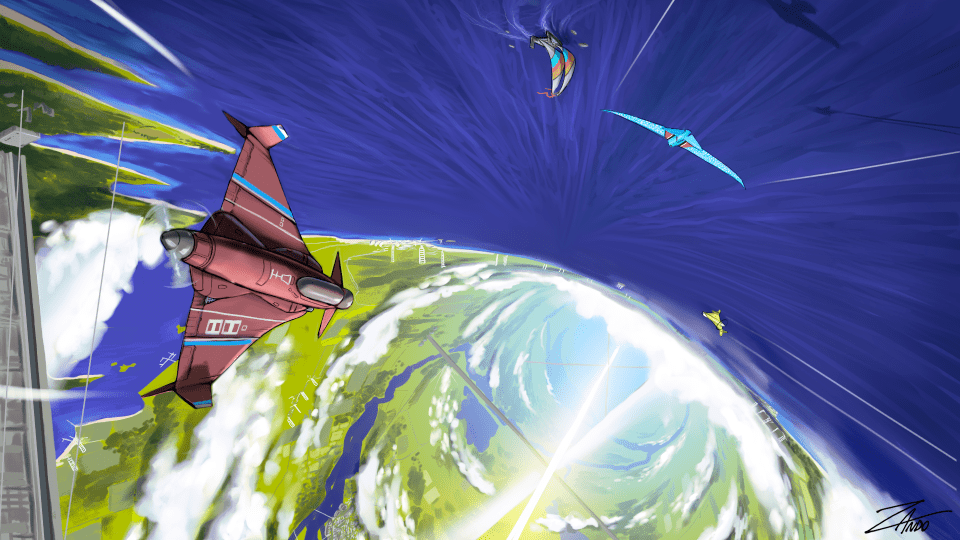
The first purpose built space dwellings were science outposts in low Earth orbit in the mid twentieth century. The Skylab and Salyut constellations are said to have numbered in the dozens by the end of the century. However, these dwellings were miniscule in comparison to the cities of the following centuries. By and large, they were used in scientific, military and infrastructure roles. There were no true residents of space in this era. With few exceptions, all humans began and ended life on Earth.
These first habitats were built at great expense, often piece by piece from construction materials launched from Earth. In the early twenty first century, space manufacturing capacity increased greatly and the continental nations began testing the limits of orbital construction. Habitats became more ambitious in scale and engineering, many built with the prospect of long term dwelling. The first permanent habitats were completed on Luna in 2034. Atlantis, the first large scale spin station, was completed in Earth orbit in 2080, nearly forty years after the first asteroids were delivered into Earth sphere for deconstruction.
In-space construction only grew rapidly from these early days. By the 2090s there were humans living long term at asteroid sites. Arisa Mons opened in 2108. The reactor on Aries Wheel went live in 2121, becoming the first artificial gravity city beyond Earth’s sphere of influence. Venus sphere followed in 2161, Jupiter in 2171, Saturn later in the decade.
A Species in the Void
Reymond C. Armandez was the first person to live his entire natural life off Earth when he died in 2155 at the age of 62.
The loss of Earth in 2181 spelled doom for many of the early cities, as few were completely self sufficient. The apocalypse would change the course of humanity forever, encouraging a new era of self-sufficient mega cities. The term world was no longer reserved for that of planets. Rather, a world was a human space, a place for living and surviving, a realm to which people could continue the legacy of their lost homeworld.
The Gravity Tax
Planetary dwelling fell out of favor in the centuries following the apocalypse. This is partly attributed to the ease and scale of space construction. Cities could be built rapidly now, especially with nearby asteroid materials. Tubeworlds and ring cities could now easily accommodate Earth standard gravity and circulate centuries of atmosphere. It was becoming easier to live in these cities than it was on the surface of Mars or the microgravity states of any moon. Widespread access to asteroid processing meant that most organizations could build a city in just a decade or two, so long as they had enough overhead capital.
Moons, Mars and the remains of Terra had to accept the tyranny of the gravity tax. Every kilogram of cargo moved up and down from the surface cost it’s own mass in fuel and operations. With the competitive costs of space construction, it became more expensive to live on the surface of Mars than it did in orbit above it. So ended the planetary era.
The great realms of human habitation dispersed throughout Sol over the remaining centuries, typically coalescing into several common categories.
Tubeworlds
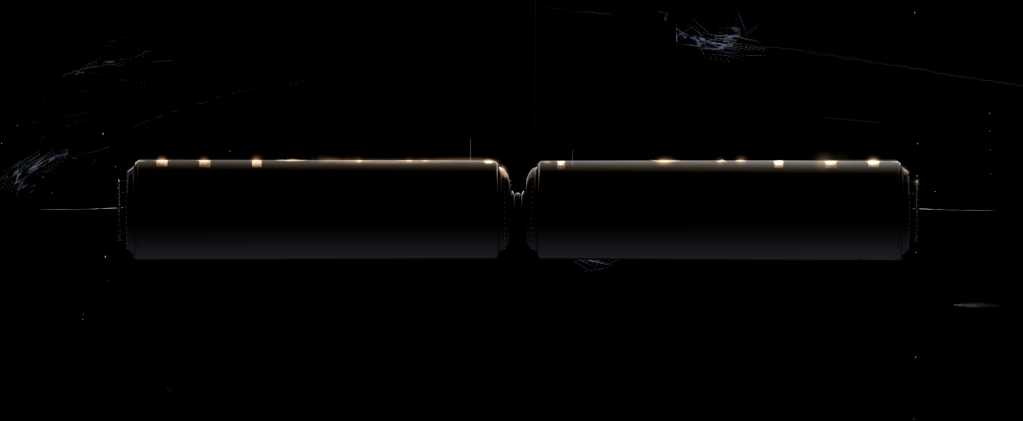
Tremendous cylinders, usually built in counterrotating pairs to counteract gyroscopic effects, though individual cylinders may be housed inside micro-moons or asteroids. They are built end to end or side by side. These worlds are thick-skinned and fusion powered with long sunlamps stretching the cylindrical interior. The inside skin of the tubeworld experiences approximate Earth gravity as the entire cylinder spins on it’s long axis.
Commonly, tubeworld orbitals have a spin-stabilized spaceport on one end and a powerplant on the opposite. The exterior skin of the orbital is thick with melted asteroid material, ice and structural filaments. Some have photovoltaic systems and heat rejection coating the outside.
It is no exaggeration to call the tubeworld the new standard of living for most of human kind. There are many hundreds of cylinder worlds. They occupy every sphere, every orbit and every altitude over the sun. From scorching Mercury to isolated Sedna. Their size and excess ensure that the majority of Sol citizens spend their entire lives in these worlds.
Ringworlds
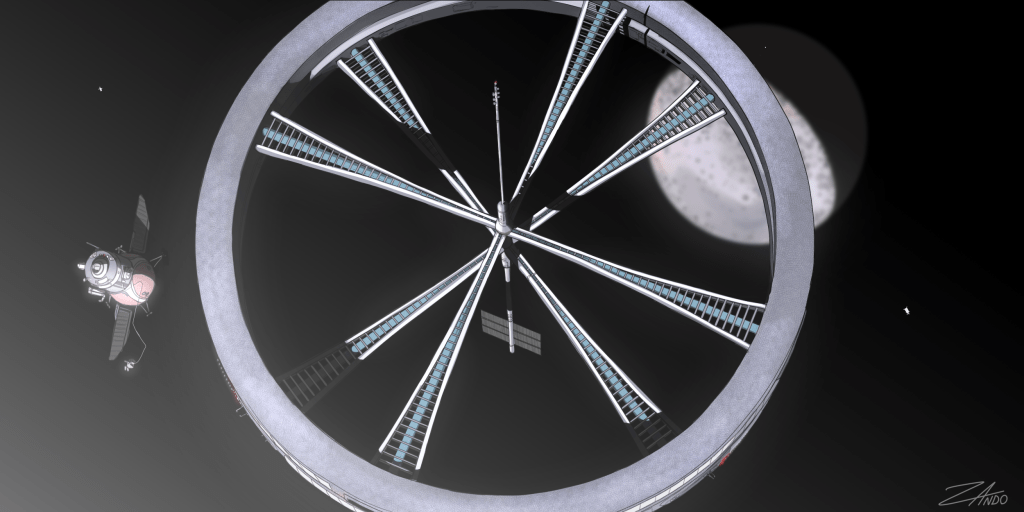
A more diverse type of orbital. Ringworlds resemble giant wheels, usually built in counterrotating pairs to counteract gyroscopic effects, sometimes with as many as 8 wheels on one axle. The smallest of these wheels are just a kilometer in diameter, but the largest are 8 or 9 kilometers across. Much like tubeworlds, most are spun to a standard Earth gravity, but their various sizes allow for a range of gravitational choices. Some cities in Luna sphere actually match a lunar gravity, for example.
Ringworld orbitals are fusion, fission or solar powered. A powerplant normally sits on the long axle shaft. The opposite end of the axle may hold a spaceport or a heat rejection system. Many rings have exterior spaceports, colloquially called spinports.
Lobeworlds
Lobeworlds is a more general term to cover most other spin-type orbitals. The most common are rotating dumbbell types, which function more like ringworlds, and diamond worlds, which function similarly to tubeworlds. In principle, they still function with the same rules of gravity, power generation and space interface as the more common variants. They may offer various gravity conditions for their inhabitants. Diamondworlds in particular, due to their interior shape (two cones, end to end), have a gravitational gradient along the interior.
Lobeworlds are less common, with the greatest concentration in the planetary trojans in the deep Kuiper belt. In many cases, a lobeworld may be constructed in a sphere where asteroid resources have yet to arrive. This is often the case in the Kuiper belt where asteroid and comet deliveries sometime take decades. A counterrotating dumbbell might require less resources and could be rebuilt into a future ringworld.
Irregulars
Irregular cities are non-spin gravity dwellings, not unlike those of early space exploration, though usually on a grander, more capable scale. These exist in abundance, but are usually small. Irregular settlements might service construction projects, military facilities, science facilities, mining projects or private institutions or resorts.
In some cases, an irregular city may simply be a repurposed spacecraft.
Surface Settlements
**Coming Soon**
 Hibour