Art and Music
History
Humanity thrives on creative expression. It literally can’t seem to help itself. Indeed, even in Earth’s darkest hour, the endless churn of imagination continued. The loss of Earth defined the Post-Earth Finalism movement, expressed in nearly all forms of media, that thrived for about two decades after the apocalypse. Art has flourished since that time, flowing into all reaches of the solar system as humankind grew anew.
Art and Visual Media
Traditional art saw a resurgence after the loss of Earth. Much like writing, the overwhelming loss of digital storage and the means to use it encouraged a generation of space dwellers to pick up pencils and brushes, make ink and paint out of whatever they could find, and start creating.
Digital mediums never vanished completely. The means by which to create visual art quickly returned. Art is hosted in museums and homes, galleries and public spaces, in transports and in the mindscape networks. Expression knows no limits.
A non-encompassing list of visual art forms practiced in 2373:
- Painting
- Drawing
- Printing
- Sculpture
- Digital/Computer arts
- Photography and imaging
- Metallurgy
- Architecture
- Somnoptics
- Hydrotecture
- Landscaping
- Tattoo
Performance and Dance
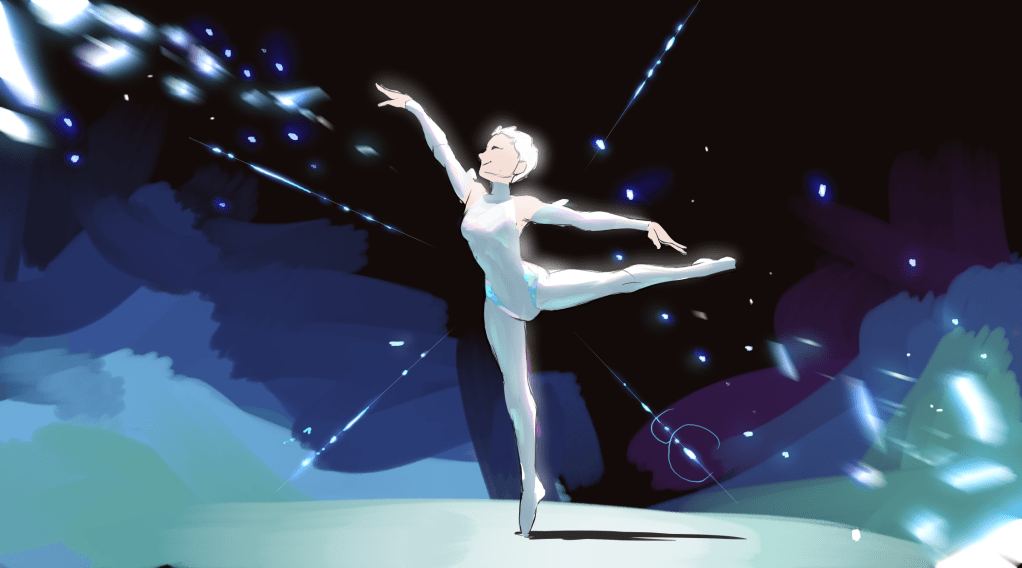
Performance exists in many forms in the twenty fourth century. Every conceivable genre and style, to some extent or another, is likely practiced somewhere. Traditional theater involving plays, musicals and dances are commonplace. Cultural performances vary widely, and may be used in celebrations or local ceremonies. Casual dancing is an activity enjoyed by many. Of course, comedy and speaking performances are still a popular form of entertainment as well.
Music
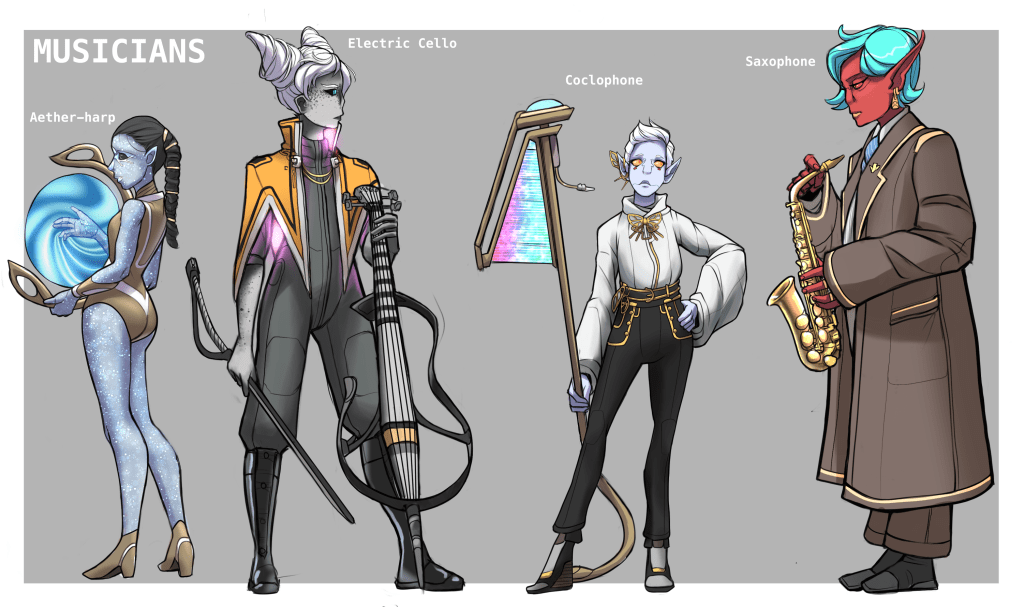
Like so many other things, traditional music saw a resurgence in the post-TIE era. Prior to the apocalypse, a lot of music was either partially or entirely created via artificial and electronic processes. Generative systems could create entire ensembles, create entire albums from nothing and produce the raw sounds of a lifetime of work in just seconds.
Much of that interest died with Earth. Today, music is as varied as any other art form, as are the people who produce it. Genres are indescribably complex and endless. Music is performed in theaters by great orchestras, yet also in packed arenas full of cheering fans. Studios record artists and market them to billions across the mindscape networks, but musicians also perform on street corners, crewmembers still ply their tunes in spacecraft quarters and vocalists share their melodic tones amongst close friends. Silent is not the black of space, as humanity has come to fill it.
The most significant evolution in music instruments has been the integration of cybernetics. Many instruments can now be tuned, altered or directly played by the use of neural implants and projectors. These instruments have spawned a vast array of new genres and musical stylings.
 Hibour